There’s a trend right now on LinkedIn where people ask their AI model of choice to make a visual that represents their “essence”.
There’s also a backlash to the trend — post after post of (well-intentioned) people making the point that generating visuals takes a lot of energy from GenAI. Not to mention, AI-generated “art” is just not great. The Olympics and the Super Bowl are prime examples of this.
There’s a second backlash to the backlash — who cares how big my carbon footprint is, as a member of the 99%? It’s the tech oligarchs and billionaires in their private jets who are ruining the planet!
As someone who wants to harness the potential of AI for regular people, small business owners, freelancers, and anyone trying to get their idea out into the world, I want to interject with a moment of curiosity on how we can do better: what if we used AI with more energy efficiency, and found ways to respect creative trades?
The cost of a GenAI image
I asked Claude what it thought about the environmental impact of redos. I included my prompt’s reasoning that a GenAI graphic may have to be regenerated a few times until a user is happy with the outcome. It agreed: “Studies on human-AI creative workflows suggest people typically iterate 3-7 times on generative image outputs before being satisfied. That’s not negligible at scale.” When asked for a source, it said “Good news and bad news. There is real academic research on this topic, but it actually suggests the iteration problem is considerably worse than the 3-7 figure I gave you.”

The proper source it finally gave was the Nielsen Norman Group who stated that the exploration phase typically involves creating anywhere from 20 to 80 images to increase the likelihood that one aligns with the creator’s vision. (source)
Ironically, I had to re-ask my own LLM of (current) choice to get the actual information I was looking for.
According to a 2024 study (source), a single image can use the same amount of electricity as charging an average smartphone halfway — or a heck of a lot more, if the model is inefficient. Like, 1450 times more.
The productivity gained is real, however, with marketers reporting that they now save 3 hours per piece of content by using GenAI (source). Conversely, 52% of consumers say they would feel less engaged with content if they suspect it’s AI-generated. (source)
Therefore:
- Yes, you’re saving time
- However, you’re using a LOT of energy
- And you may be harming your brand’s reputation
This is probably because GenAI is still easy to spot. I know a lot of models are making progress in this space, but people are starting to even believe real images or videos are AI. Head over to /r/isthisai and you’ll see what I mean.
So, what can you do?
Templating + AI
This is a solution I’m using more and more in my customer work and prototyping: a template outlining what I basically want (with branding, font families, and predetermined colour codes) and a little AI “magic” to get it to something useable.
Here’s a basic workflow:
- Fill in a form with your requirements: what the post is for, what information should be included, what types of images should be used (from a pre-selected library of brand-specific photography, or a free image source like Pexels), what colours should be used, and which template should be used
- Validate the output from Templated.io / Bannerbear / or a Crystallized Intelligence workflow
- Generate the final PNG + accompanying text
- Send it automatically to your social media posting tool: Buffer, Hubspot, Odoo, or directly to the social media site through an Agent or workflow integration
And voila, something useable for your company, with only a few tweaks to be made.
The beauty being, that you only use GenAI for text-based applications except if you want to create your own templates.
Using the figures from a 2025 study (source), generating a template yourself using HTML and CSS through an AI model will cost approximately 0.4–1.8 Wh per template, which will be re-used over and over. Then, the rest of the workflow to create an image from the template takes ~0.005–0.03 Wh.
I call this the Crystallized Intelligence version because I already have a workflow that can handle this method. You can get in touch if you want to learn more.
Compared to 2–10 Wh per pure GenAI image, you’re saving magnitudes of energy per social media post. 100–2,000×
To give an example of this output, here is a social media image I generated, after first using a Canva template as a base:
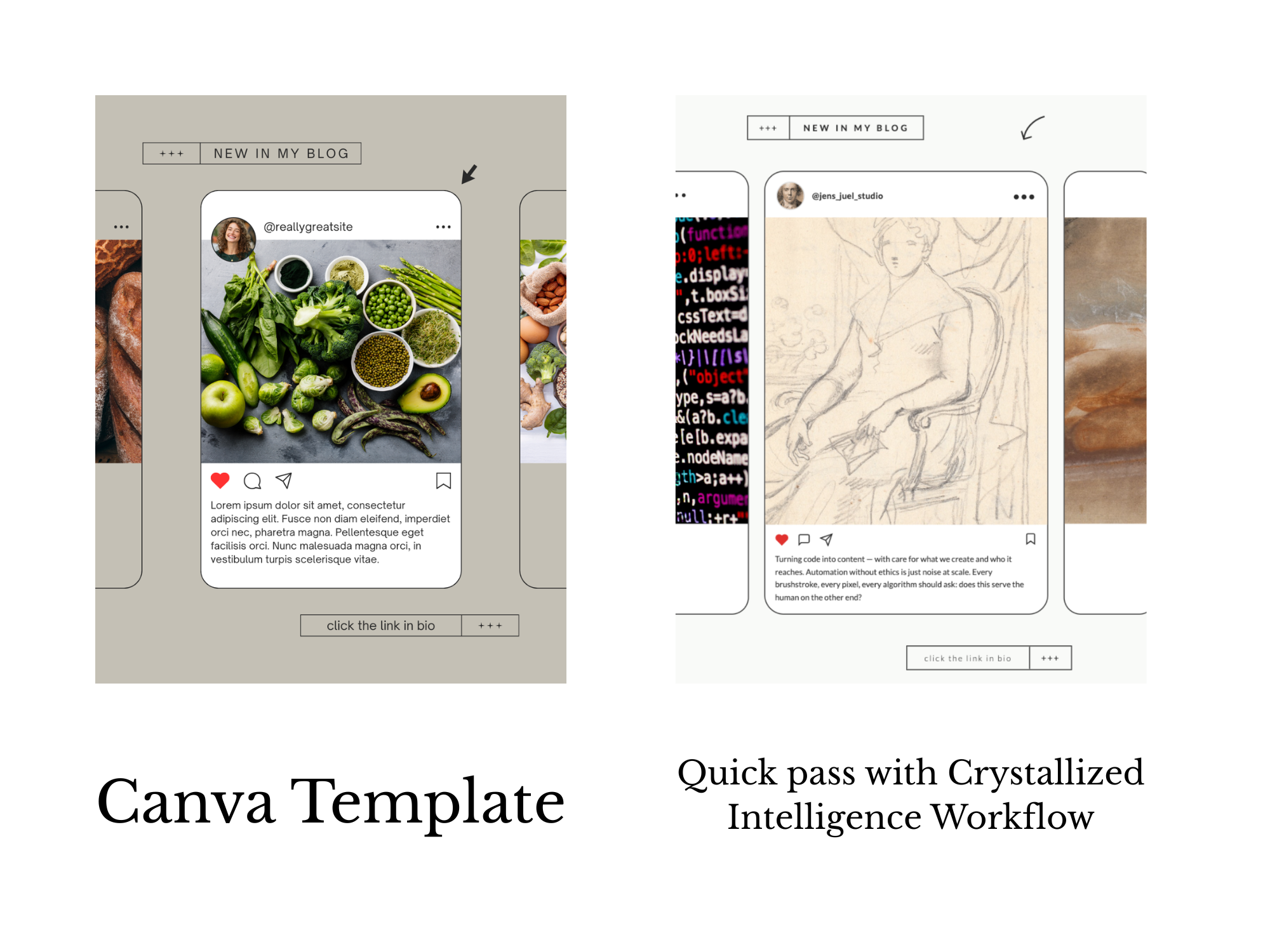
Note: you should probably have a Canva Pro account if you’re going to do this. Like I do. Don’t come at me, Canva. Open your API to us regular pro account users, please.
How does this respect creative trades?
This method uses real images from real artists. Preferably those artists are being paid, but if your budget is tight, Pexels or other sources are acceptable (until you can afford something custom). Personally, I use a lot of classical art in my branding, which are in the public domain.
Someday I aim to hire a painter to create a series that will be only for my company. But until then, I am building a business, brick by brick, and want to help you do the same.
You can also hire a graphic design creative to design your templates, curate your library of images, and create a visual identity that is solely for you.
Whatever you choose, please remember that we’re all in this together. AI is a powerful tool for equalising opportunity, but it can also do real harm to our environment, and your brand’s reputation.
If you’re looking for an AI consultant who values small business and workers, please get in touch today.
Finally, rest in peace Catherine O’Hara. I hope you didn’t mind I used some of your iconic gifs from your role as Moira Rose.